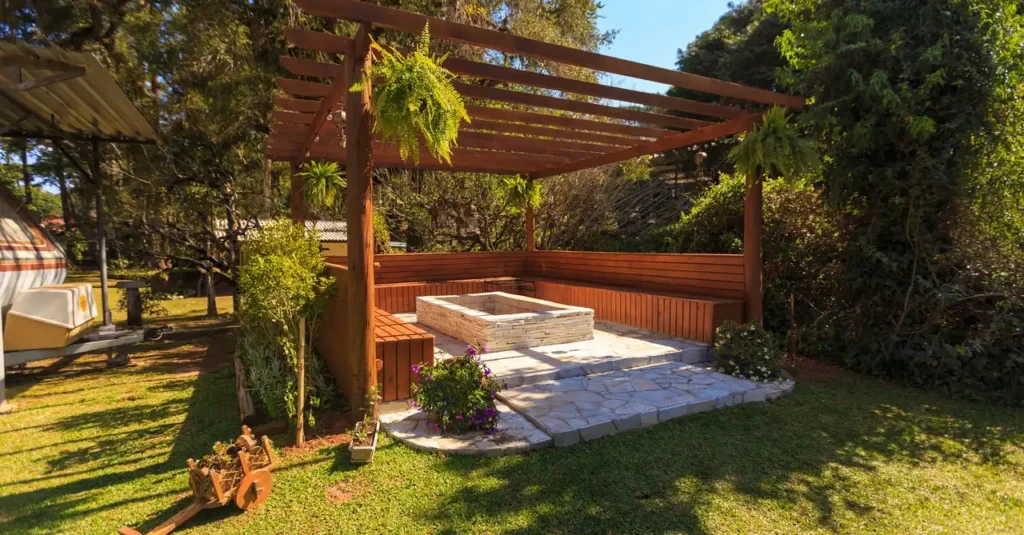
There’s no single figure we can give you for a patio, and honestly, any contractor who quotes you a price over the phone without seeing the garden is guessing. What a patio actually costs depends on the size, the material, how much groundwork your site needs, and access. The best way to get a real number is to have us out to measure the space and tell you what’s involved for your specific garden.
Why patio pricing varies so much from one Kildare garden to the next
We’ve laid patios in new-build estates around Celbridge and Sallins where the ground is flat, the access is good and the job goes in over a few days without a hitch. We’ve also done jobs in older parts of Naas and Athy where there’s a step change in level from the house to the garden, old concrete to break out first, or a gate too narrow for a machine to get through. Same size patio, same material, completely different job underneath. That’s the part most price guides online miss. The flags are often the smaller part of the bill. The groundwork, the base, the drainage, and the labour to get everything level and sound is where most of the variation comes from.
Size: why doubling the area doesn’t double the cost
A small seating patio off the back door is a different job to a full-width patio running the length of a semi-detached garden in Newbridge or Leixlip. Bigger areas use materials more efficiently, there’s less cutting and wastage, and the excavation and base work can move faster once the machine is set up and working across a wider space. So larger patios often work out better value per square metre than small ones, even though the total job costs more. If you’re on the fence about size, it’s worth discussing with us whether extending the patio now, while the groundworks are already underway, makes more sense than coming back to extend it in a few years.
Material: the single biggest decision you’ll make
This is where most of the price difference between quotes actually comes from. Broadly, homeowners in Kildare are choosing between:
- Concrete paving flags, the most budget-friendly option, widely available, decent range of colours and finishes, good for most gardens.
- Natural stone such as limestone, sandstone or granite, which costs more to buy and is heavier to lay, but has a look and durability that concrete flags don’t quite match, and it tends to age well.
- Porcelain paving, increasingly popular, low maintenance, resists staining and algae better than natural stone, but needs an accurate base and careful laying, so labour costs can be higher.
- Block paving or setts, often used for borders, paths or mixed-material patios, good for tying a patio into a driveway or path elsewhere in the garden.
None of these is automatically the “right” choice. It genuinely comes down to the look you want, how much maintenance you’re willing to do, and what the rest of your garden and house exterior is doing stylistically. We’d rather talk you through the real trade-offs on site than steer you toward whatever’s easiest for us to lay.
Ground conditions: the Kildare factor people don’t expect
A lot of ground across Kildare, particularly on the heavier clay soils you get around Kildare town, Clane and parts of Athy, holds water more than people expect. If the base and drainage aren’t done properly, a patio can look fine for the first year or two and then start to dip, crack or pond water after heavy rain. This is the single biggest mistake we see when we’re asked to fix someone else’s patio: not enough sub-base depth, no proper fall for water to run off, or drainage that was never tied into the garden’s natural slope. Getting this right costs more upfront than skipping it, but it’s the difference between a patio that lasts twenty years and one that needs digging up in five.
Access and site prep
If we can get a mini digger and a dumper truck into your back garden, the job moves quickly and that keeps costs down. If everything has to go through a narrow side passage by hand, barrow by barrow, that adds real time to the job and it will show up in the quote. Removing an old patio, a shed base, or overgrown planting before we start also adds to the job. If your garden needs a proper clearout first, it’s worth looking at garden landscaping as a whole rather than treating the patio as an isolated job, especially if you’re planning other changes at the same time.
Planning permission: what to check before you commit
Most straightforward patios at ground level don’t trigger planning permission, but raised patios, large decked areas attached to a patio, or anything that affects drainage near a boundary can be a different story, and rules can vary depending on your specific site and whether the property is in a protected structure or estate with its own conditions. We’re not planning consultants, so if there’s any doubt, check directly with Kildare County Council before work starts rather than relying on a general rule of thumb from the internet.
What pushes a patio quote up or down
- Pushes it up: natural stone or porcelain, poor access, heavy clay or wet ground, removing an old patio or concrete first, steps or level changes, intricate cutting around curves or features.
- Keeps it down: concrete paving flags, good machine access, flat and reasonably well-drained ground, a simple rectangular layout, doing the groundwork at the same time as other garden works to share site setup costs.
How we price a patio job
We measure the area, check the ground, look at access, and talk through materials with you before we give a figure. That’s the only honest way to do it. If you’ve got a rough idea of size and material in mind already, that helps us give you options rather than one fixed quote. We’ve been doing this across Kildare, from Maynooth to Athy, for over 21 years, and the jobs that go smoothly are almost always the ones where the groundwork got proper attention before a single flag went down.
If you’d like an honest, no-nonsense quote for your own garden, get in touch through our contact page or have a look at our patios and paving page for examples of the work we do across the county. And if the patio is just one part of a bigger garden plan, our landscaping service covers the project end to end.
Frequently Asked Questions
Is natural stone always better value than concrete paving in the long run?
Not always. Natural stone tends to last longer and weather well, but a well-laid concrete flag patio with a proper base can also give you decades of use. It comes down to how much you’re willing to spend upfront versus the look you want. We’d rather show you both options in person than tell you one is universally better.
Can I lay a patio myself to save money?
You can, and plenty of people do for small areas. Where it usually goes wrong is the base: not enough depth, wrong type of hardcore, or no fall built in for drainage. If you’re doing it yourself, get the sub-base and drainage right before you touch a single flag, because that’s the part that’s expensive and disruptive to fix later.
How long does a typical patio job take?
A straightforward patio with good access might take a few days from start to finish. Jobs with poor access, a lot of groundwork, old concrete to remove, or complex layouts can take noticeably longer. Weather also plays a part, as heavy or prolonged rain can slow down groundworks in particular.
Do I need planning permission for a patio in Kildare?
Most ground-level patios don’t require planning permission, but raised patios, certain boundary situations, or protected structures can be treated differently. Check with Kildare County Council directly if you’re unsure, rather than assuming based on a neighbour’s job or something you read online.
What’s the best time of year to have a patio laid in Kildare?
Spring and early autumn tend to give the most workable ground conditions and weather, but we lay patios through most of the year. Winter jobs are possible too, it just depends on how wet the ground is and whether frost is likely during the laying and curing period.
Should I combine my patio with other garden work to save money?
Often yes, if you know you want a patio, new fencing, or raised beds done around the same time, it makes sense to plan them together. Sharing site setup, access arrangements and machine hire across jobs can bring the overall cost down compared to doing each one separately a year apart.